Electrolysis of Water: Apparatus Diagram, Electrodes and Half-Reactions
Master the electrolysis of water diagram. Understand oxidation vs reduction, Hoffman voltameter, electrode polarities, and the 2:1 gas volume ratio.
Level: High School Chemistry, AP Chemistry, Electrochemistry
In this guide
Quick answer
Electrolysis of water uses an external direct current (DC) power source to drive the non-spontaneous decomposition of water into hydrogen and oxygen gases (2 H₂O ⟶ 2 H₂ + O₂). Reduction occurs at the negative cathode producing hydrogen gas, while oxidation occurs at the positive anode producing oxygen gas. Under identical conditions, the volume of hydrogen produced is exactly twice the volume of oxygen.
Key relationships & formulas
- Overall decomposition: 2 H₂O(l) ⟶ 2 H₂(g) + O₂(g)
- Cathode (Reduction): 4 H₂O + 4 e⁻ ⟶ 2 H₂(g) + 4 OH⁻ (E° = −0.83 V)
- Anode (Oxidation): 2 H₂O ⟶ O₂(g) + 4 H⁺ + 4 e⁻ (E° = +1.23 V)
- Net Cell Potential: E°_cell = −2.06 V (Requires external V > 1.23 V)
- Avogadro's Law: V ∝ n ⟹ Volume H₂ : Volume O₂ = 2 : 1
Why Pure Water Does Not Undergo Electrolysis
If you submerge two wires connected to a 9V battery into pure deionized water, almost nothing happens. Why? Pure water has an extremely low concentration of ions ([H⁺] = [OH⁻] = 1.0 × 10⁻⁷ M), meaning its electrical conductivity is far too poor to carry an appreciable current.
To conduct electrolysis in a school laboratory or industrial setup, an electrolyte like sulfuric acid (H₂SO₄) or sodium hydroxide (NaOH) is added. The inert electrolyte ions carry charge through the solution without being oxidized or reduced themselves.
The Hoffman Voltameter Apparatus Explained
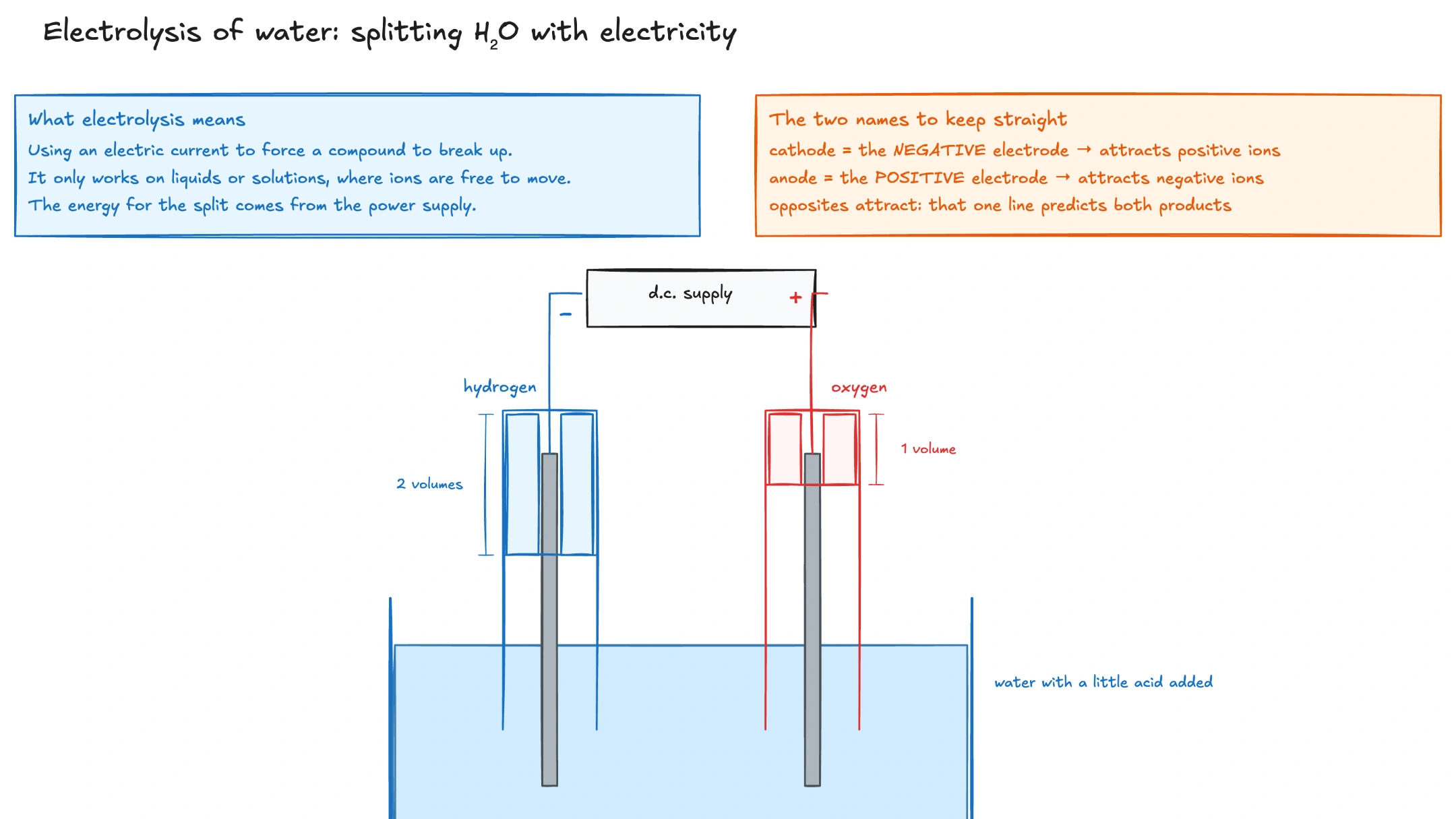
The classic laboratory apparatus for this experiment is the Hoffman voltameter, consisting of three interconnected vertical glass cylinders with platinum electrodes sealed at the base:
• Direct Current (DC) Supply: Pushes electrons into one electrode and draws them out of the other.
• Negative Electrode (Cathode): Connected to the negative terminal of the battery. Electrons accumulate here, driving reduction.
• Positive Electrode (Anode): Connected to the positive terminal of the battery. Electrons are pulled away, driving oxidation.
• Inverted Gas Tubes: As gases form, they displace liquid downward. Even from across the room, you will notice that the liquid level above the cathode drops twice as fast as the level above the anode!
The Half-Reactions: RED CAT and AN OX
Never mix up your electrodes again! Use the universal chemistry mnemonics:
• RED CAT = REDuction occurs at the CAThode.
Water molecules accept electrons from the electrode surface to form hydrogen gas and hydroxide ions: 4 H₂O(l) + 4 e⁻ ⟶ 2 H₂(g) + 4 OH⁻(aq).
• AN OX = ANode is where OXidation occurs.
Water molecules surrender electrons to the electrode surface to form oxygen gas, protons, and free electrons: 2 H₂O(l) ⟶ O₂(g) + 4 H⁺(aq) + 4 e⁻.
Notice that 4 electrons are transferred in both half-reactions. Adding them together cancels the electrons: 4 H⁺ + 4 OH⁻ recombines into 4 H₂O, leaving the net reaction: 2 H₂O(l) ⟶ 2 H₂(g) + O₂(g).
Why the Gas Volume Ratio Is Exactly 2:1
Students often wonder: 'Why does hydrogen take up twice as much space as oxygen? Doesn't oxygen have much heavier molecules?'
Here is where Avogadro's Law applies: equal volumes of all gases at the same temperature and pressure contain equal numbers of molecules (V ∝ n). The stoichiometry of 2 H₂O ⟶ 2 H₂ + O₂ produces exactly 2 moles of H₂ gas for every 1 mole of O₂ gas. Therefore, the volume of hydrogen collected in the cathode tube is exactly double the volume of oxygen in the anode tube.
Watch Claryfied Draw the Electrochemical Cell in Real Time
In Claryfied, this abstract electrochemistry lesson is transformed into an animated whiteboard diagram. The AI tutor sketches the cell, color-codes the anode and cathode, draws rising gas bubbles in the 2:1 ratio, and tracks electron circulation through the external wire with clear voice narration.
Watch our live electrolysis lesson on Claryfied, or enter any electrochemistry problem (galvanic vs electrolytic cells, Faraday's laws, Nernst equation) to have Claryfied sketch and explain it for you.
What to remember
- Electrolysis is an electrolytic process: an external voltage forces an endergonic, non-spontaneous reaction (ΔG > 0) to occur.
- Reduction ALWAYS happens at the cathode (RED CAT); oxidation ALWAYS happens at the anode (AN OX).
- In an electrolytic cell, the cathode is negative (connected to battery −) and the anode is positive (connected to battery +).
- The balanced equation produces 2 moles of H₂ gas for every 1 mole of O₂ gas, creating a visible 2:1 volume ratio in gas tubes.
- Claryfied illustrates the Hoffman voltameter, tracks electron circulation, and explains electrode chemistry out loud.
Frequently asked questions
How do you test the gases collected during electrolysis?
For hydrogen (collected at the cathode), bring a burning splint to the mouth of the tube: it ignites with a characteristic squeaky 'pop'. For oxygen (collected at the anode), insert a glowing splint: it immediately relights.
Why is the cathode negative in an electrolytic cell but positive in a galvanic cell?
In an electrolytic cell, an external battery forces electrons onto the cathode, making it negative. In a galvanic (voltaic) cell, spontaneous chemical oxidation dumps electrons onto the anode, making the anode negative and the cathode positive. However, reduction ALWAYS occurs at the cathode in both cell types!
Can table salt (NaCl) be used as the electrolyte for water electrolysis?
Using NaCl introduces chloride ions (Cl⁻). Because chloride is more easily oxidized than water at typical voltages, chlorine gas (Cl₂) is produced at the anode instead of oxygen, which is hazardous and changes the experiment into the chloralkali process.
Watch a Live Electrolysis of Water Lesson on Claryfied
Play this complete interactive lesson free—drawn and narrated from start to finish. Or enter your own homework problem to get 5 lessons free.