How to Balance Chemical Equations: A Visual Atom-Inventory Method
Learn how to balance chemical equations with a visual atom-inventory method. Master conservation of mass, polyatomic ions, and tricky combustion reactions.
Level: Middle School Science, High School Chemistry, AP Chemistry
In this guide
Quick answer
Balancing a chemical equation means placing whole-number stoichiometric coefficients before chemical formulas so the total number of atoms of each element is identical on the reactant (left) and product (right) sides. This satisfies the Law of Conservation of Mass. Subscripts inside formulas must never be altered because doing so changes the chemical identity of the substances.
Key relationships & formulas
- Combustion example: CH₄ + 2 O₂ ⟶ CO₂ + 2 H₂O
- Reactant atoms: 1 C, 4 H, 4 O
- Product atoms: 1 C, 4 H, 4 O
- Mass Conservation: Total Reactant Mass = Total Product Mass
The Law of Conservation of Mass: Why Balancing Is Mandatory
In 1789, Antoine Lavoisier established that mass is neither created nor destroyed during chemical reactions. When methane burns in oxygen gas to produce carbon dioxide and water, every single carbon, hydrogen, and oxygen atom present at the start must exist at the end.
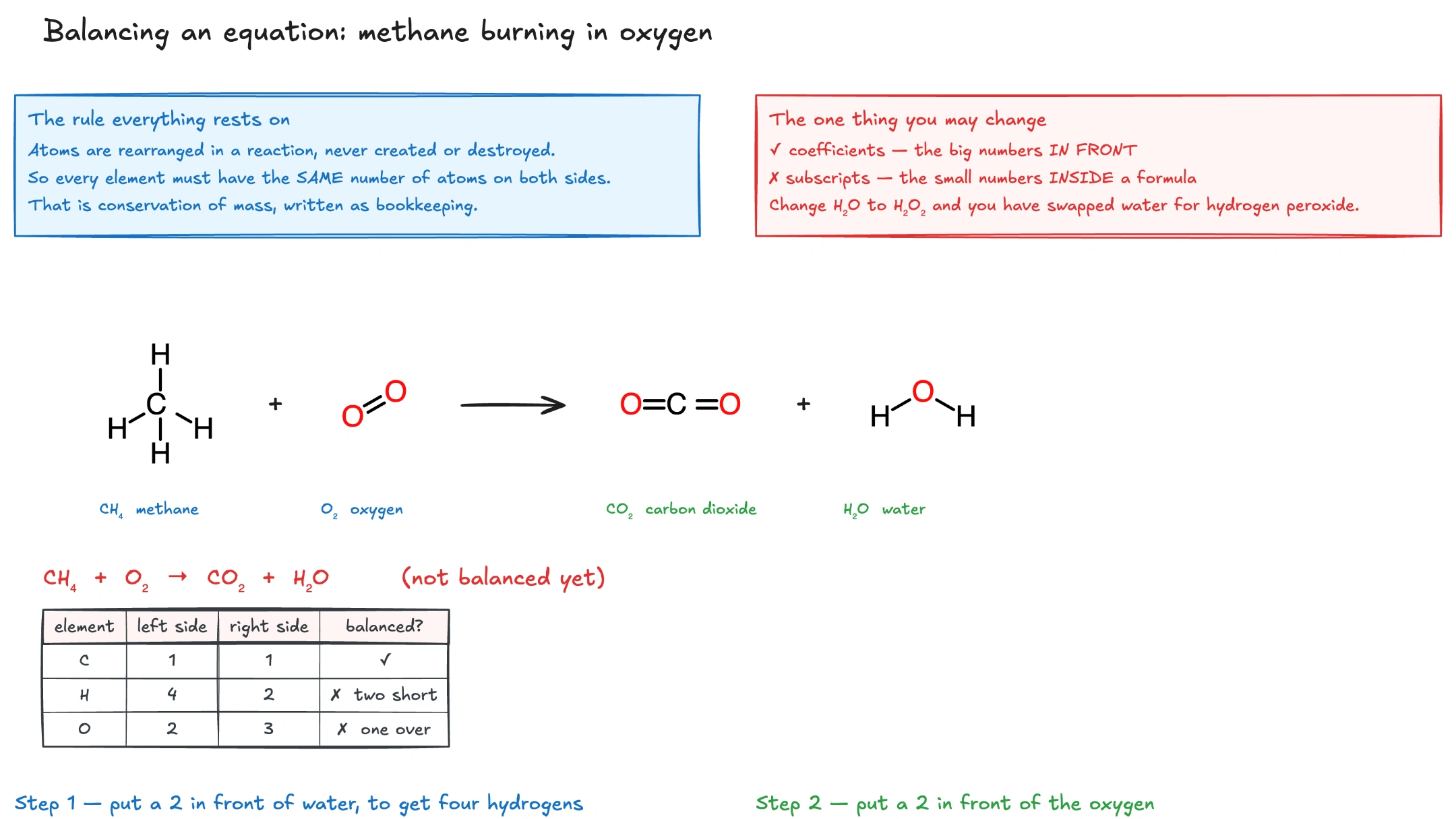
Writing CH₄ + O₂ ⟶ CO₂ + H₂O is chemically incomplete because the left side contains 4 hydrogen atoms while the right side only has 2; similarly, the left has 2 oxygens while the right has 3. Balancing is the bookkeeping method that aligns our chemical equation with physical reality.
The Golden Rule: Coefficients vs. Subscripts
If there is one rule you must never violate, it is this: you can only add or change COEFFICIENTS (the large numbers in front of a formula). You must NEVER touch a SUBSCRIPT (the small numbers inside a formula).
Why? A coefficient multiplies the number of molecules: 2 H₂O means two separate water molecules. But changing a subscript alters the molecular identity itself: changing H₂O to H₂O₂ turns life-sustaining drinking water into toxic hydrogen peroxide! Always leave chemical formulas untouched inside their boxes.
The 4-Step Atom Inventory Strategy
Instead of guessing numbers randomly, follow this foolproof 4-step sequence (the MINOH rule: Metals, Ions, Nonmetals, Oxygen, Hydrogen):
- 1. Build the Initial Inventory: Draw a line down from the arrow. Write each element symbol and tally the exact count on the reactant and product sides.
- 2. Balance Elements Appearing in Only One Compound First: Start with unique metals or nonmetals (like carbon in CH₄ and CO₂). Here, 1 C on left matches 1 C on right.
- 3. Balance Hydrogen: The left side has 4 hydrogens in CH₄; the right has 2 in H₂O. Place coefficient 2 in front of H₂O: now right side has 2 × 2 = 4 hydrogens! Update your inventory immediately.
- 4. Balance Oxygen Last: On the right side, we now have 2 oxygens in CO₂ plus 2 oxygens in 2 H₂O = 4 oxygens total. The left side has O₂ (which comes in pairs). Place coefficient 2 in front of O₂: 2 × 2 = 4 oxygens. The equation is fully balanced: CH₄ + 2 O₂ ⟶ CO₂ + 2 H₂O!
Pro-Tip: Treating Polyatomic Ions as Single Units
When balancing reactions involving polyatomic ions that stay intact on both sides—such as sulfate (SO₄²⁻), nitrate (NO₃⁻), or phosphate (PO₄³⁻)—do NOT split them into separate sulfur and oxygen atoms! Treat the entire group as one single block.
For example, in BaCl₂ + Na₂SO₄ ⟶ BaSO₄ + 2 NaCl, treat 'SO₄' as a single unit. There is 1 SO₄ on the left and 1 SO₄ on the right. This single trick cuts balancing time in half.
Watch Claryfied Sketch Molecules and Balance Equations
Balancing equations becomes effortless when you can actually see the molecules. In Claryfied, the AI tutor sketches the chemical formulas, groups individual atom clusters visually, tracks a live atom-count scorecard, and explains why coefficients change with synchronized voice narration.
Play our balancing equations sample lesson on the live board, or enter your most complicated combustion or precipitation equation into Claryfied to watch it solved step by step!
What to remember
- The Law of Conservation of Mass dictates that atoms cannot be created or destroyed in a chemical reaction.
- Change coefficients (the numbers in front), NEVER subscripts (the small numbers inside formulas).
- Follow a structured sequence: balance metals first, nonmetals next, and save hydrogen and oxygen for last.
- Claryfied illustrates molecule clusters, updates live atom counts, and shows why equations balance on an interactive whiteboard.
Frequently asked questions
What should I do if I get an odd number of oxygens like 7/2 O₂ in a combustion reaction?
This frequently happens with alkanes (like C₂H₆ + 3.5 O₂ ⟶ 2 CO₂ + 3 H₂O). Temporarily use the fraction 7/2, and then multiply the ENTIRE equation by 2 to clear the fraction: 2 C₂H₆ + 7 O₂ ⟶ 4 CO₂ + 6 H₂O.
Can an equation have multiple correct sets of coefficients?
While 2 CH₄ + 4 O₂ ⟶ 2 CO₂ + 4 H₂O has equal atom counts, standard chemistry conventions require the lowest whole-number ratio (1:2:1:2).
Can Claryfied balance redox equations in acidic or basic solution?
Yes! Claryfied handles complex redox balancing using the half-reaction method, adding H₂O, H⁺, OH⁻, and electrons step by step on the whiteboard.
Watch Chemical Equations Balanced Visually on Claryfied
Play this complete interactive lesson free—drawn and narrated from start to finish. Or enter your own homework problem to get 5 lessons free.