Series vs Parallel Circuits: A Visual Guide to Current, Voltage and Resistance
Understand series vs parallel circuits visually. Master Ohm's law, junction rules, voltage drops, and step-by-step equivalent resistance calculations.
Level: Middle School, High School Physics, AP Physics 1, Intro Electronics
In this guide
Quick answer
In a series circuit, charge flows through a single unbroken loop, meaning electric current I is identical everywhere, voltages add up (V_total = V1 + V2), and equivalent resistance is the sum (Req = R1 + R2). In a parallel circuit, branches connect across the same two potential nodes, meaning voltage V is identical across every branch, branch currents add up (I_total = I1 + I2), and equivalent resistance decreases (1/Req = 1/R1 + 1/R2).
Key relationships & formulas
- Ohm's Law: V = I · R
- Series Current: I_total = I1 = I2 = I3
- Series Voltage: V_total = V1 + V2 + V3
- Series Equivalent Resistance: Req = R1 + R2 + R3
- Parallel Voltage: V_total = V1 = V2 = V3
- Parallel Current (Kirchhoff's Junction): I_total = I1 + I2 + I3
- Parallel Equivalent Resistance: 1/Req = 1/R1 + 1/R2 + 1/R3
- Two Resistors in Parallel: Req = (R1 · R2) / (R1 + R2)
The Water Pipe Analogy That Makes Circuits Click
Electric circuits often feel mysterious because electrons are invisible. The most reliable physical intuition comes from imagining water circulating in pipes powered by a pump (the battery):
• Electric potential (Voltage, V) is the water pressure provided by the pump.
• Electric current (I, in Amperes) is the volume flow rate of water passing a point per second.
• Resistance (R, in Ohms) represents constrictions or rough sand filters that resist the flow of water.
With this visual in mind, the contrast between series and parallel becomes self-evident.
Series Circuits: One Single Path for Charge
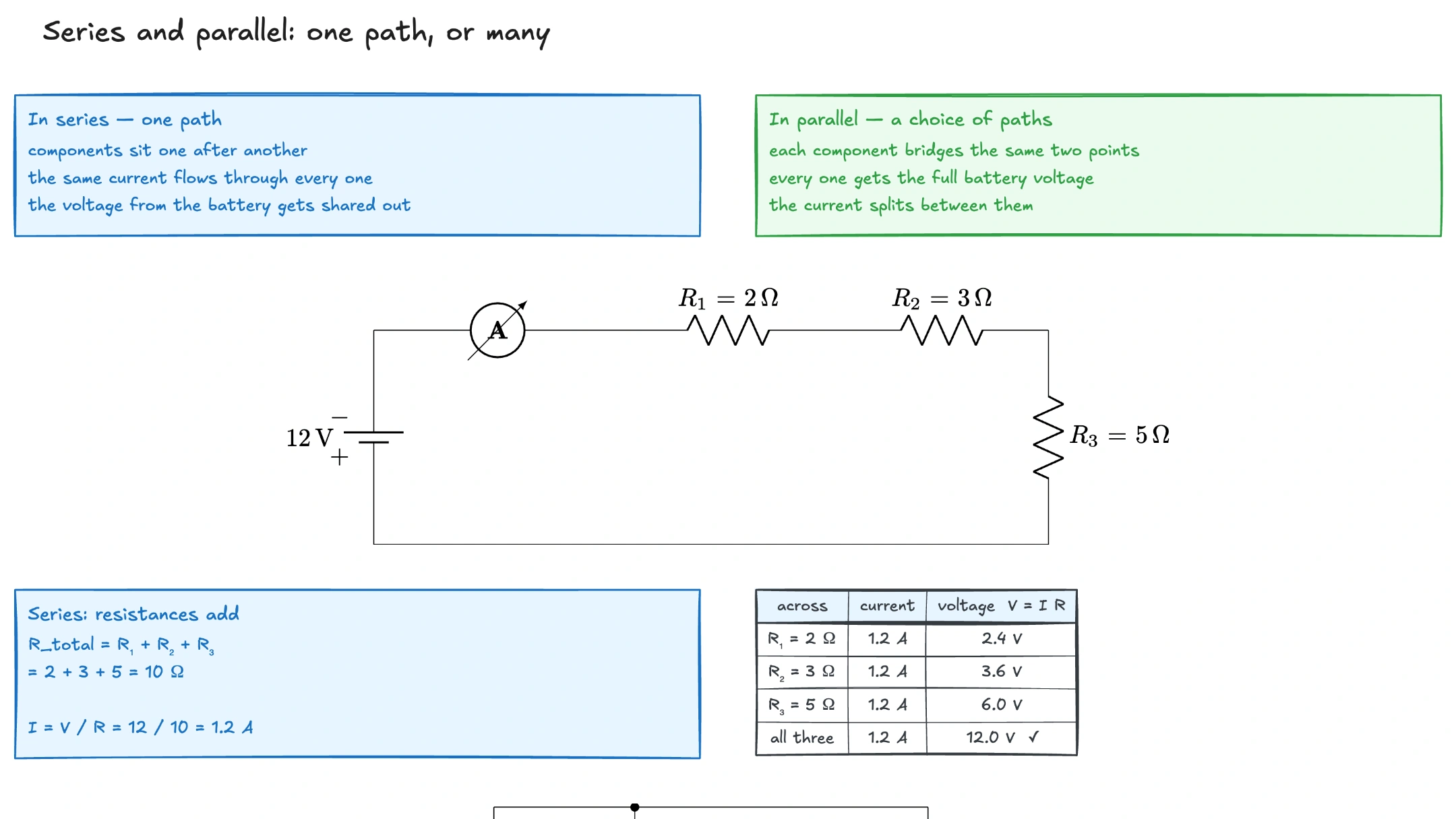
In a series circuit, resistors are connected end-to-end like cars in a single-lane tunnel. There are no junctions or alternative exits. Because charge cannot vanish or accumulate at steady state (Conservation of Charge), the rate of charge flow must be identical at every point:
I_total = I1 = I2 = I3.
As current forces its way through each successive resistor, it loses electrical potential energy. The total battery voltage V_total is shared across the resistors as individual voltage drops: V_total = V1 + V2 = I·R1 + I·R2 = I(R1 + R2).
This gives the series equivalent resistance: Req = R1 + R2 + R3. Every added resistor in series adds another restriction, reducing total current.
Parallel Circuits: Multiple Independent Highways
In a parallel circuit, the wire splits at a junction node into separate branches before rejoining. Because each branch connects directly between the battery's positive and negative terminals, every single branch experiences the exact same electrical pressure difference:
V_total = V1 = V2 = V3.
Current splits among the branches based on their resistance (Kirchhoff's Current Law): I_total = I1 + I2 = V/R1 + V/R2 = V(1/R1 + 1/R2).
This yields the famous reciprocal formula: 1/Req = 1/R1 + 1/R2. Adding more branches in parallel provides additional highways for current to escape, which actually lowers the total resistance of the circuit!
How to Tackle Complex Combination (Mixed) Circuits
Real exam questions almost always feature mixed circuits containing both series and parallel sections. Follow this 3-step reduction algorithm:
1. Find the Innermost Pure Group: Identify any two resistors that are strictly in series (no junction between them) or strictly in parallel (connected to the same two nodes).
2. Collapse and Redraw: Calculate the equivalent resistance of that small pair and redraw the circuit with a single equivalent resistor.
3. Repeat Until One Resistor Remains: Continue collapsing until you find Req_total, calculate I_total = V_battery / Req_total, and then 'unfold' the circuit backward to determine individual currents and voltages.
How Claryfied Sketches Circuits and Resolves Confusion
When you ask Claryfied to explain a circuit, you don't just see numbers. The tutor draws the battery, switches, and resistors using clean schematic symbols, traces the colored current paths through every loop, and writes out the Ohm's law equations stroke by stroke while narrating aloud.
Watch our interactive series vs parallel circuit lesson live on Claryfied, or type in a tricky schematic from your physics problem set and let Claryfied break down the equivalent resistance for you.
What to remember
- Components are in series only if every coulomb of charge passing through one must pass through the other without junctions.
- Components are in parallel only if both ends connect to the exact same pair of electrical nodes.
- Adding resistors in series increases total resistance; adding resistors in parallel creates more paths and decreases total resistance.
- Claryfied illustrates circuit schematics with standard electronic symbols, animates current flow, and walks through Ohm's law step by step.
Frequently asked questions
Why do household appliances use parallel wiring instead of series?
In parallel wiring, every appliance receives the full mains voltage (e.g., 120V in the US) regardless of how many other devices are running. Furthermore, if one lightbulb burns out or is switched off, the other branches remain complete circuits and stay powered.
What happens if you connect a 10Ω resistor in parallel with a 1,000,000Ω resistor?
The equivalent resistance is slightly less than 10Ω (approx 9.9999Ω). In parallel, the equivalent resistance is always strictly smaller than the smallest individual branch resistor because the 10Ω branch carries nearly all the current.
Can Claryfied analyze circuits with capacitors and inductors?
Yes! Claryfied can sketch and analyze RC, RL, and RLC circuits, explaining transient charging curves and impedance on the live whiteboard.
Watch Series & Parallel Circuits Explained on Claryfied
Play this complete interactive lesson free—drawn and narrated from start to finish. Or enter your own homework problem to get 5 lessons free.