Ratios and Proportions: Visual Guide to Tape Diagrams, Tables and Scaling
Master ratios, proportions, scale factors, and unit rates visually. Understand tape diagrams and why cross-multiplication works with Claryfied.
Level: Middle School Math, Pre-Algebra, High School Foundation
In this guide
Quick answer
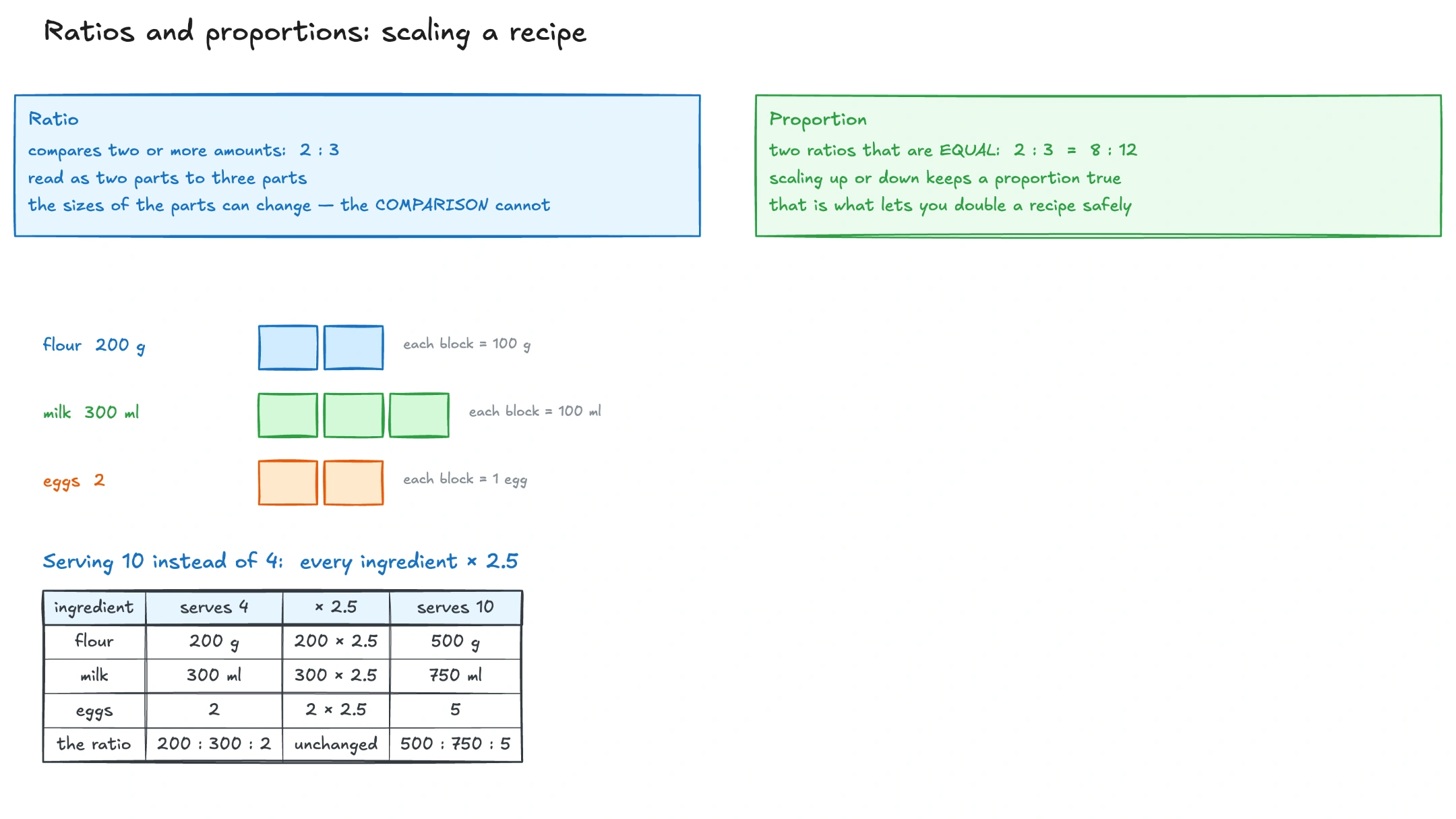
A ratio is a multiplicative comparison between two quantities (e.g., 2 cups flour to 3 cups milk), while a proportion is a mathematical statement asserting that two ratios are equal (a/b = c/d). Ratios are scaled by multiplying or dividing all terms by the same non-zero scale factor. Cross-multiplication (a·d = b·c) works because multiplying both sides by the common denominator clears fractions while preserving equality.
Key relationships & formulas
- Ratio notation: a : b = a / b
- Proportion statement: a / b = c / d
- Scale Factor k: c = k · a and d = k · b
- Cross-multiplication: a · d = b · c
- Unit Rate: r = a / b (quantity of a per 1 unit of b)
Why Ratios Confuse Students: Multiplicative vs. Additive Thinking
The most common mistake students make when first encountering ratios is treating them additively. Suppose a pancake recipe uses 2 cups of flour for every 3 cups of milk (a 2:3 ratio). If you add 1 cup of flour to get 3 cups, can you just add 1 cup of milk to get 4 cups?
No! 3/4 (0.75) is thicker than 2/3 (0.667). Ratios describe how quantities grow multiplicatively. To double the recipe, you must multiply both by 2 (4 cups flour to 6 cups milk). Visual representations like tape diagrams and tables make this distinction unmistakable.
The Power of Tape Diagrams (Bar Models)
In modern curricula (such as Singapore Math and Common Core), tape diagrams are the primary visual bridge to algebra. Consider this classic word problem:
'The ratio of boys to girls in a robotics club is 3:5. If there are 40 students in total, how many girls are there?'
Instead of setting up abstract variables, draw 3 equal boxes for boys and 5 equal boxes for girls. Together, there are 3 + 5 = 8 equal boxes representing 40 students.
Each box must equal: 40 ÷ 8 = 5 students!
Therefore, boys = 3 × 5 = 15, and girls = 5 × 5 = 25. The problem is solved in seconds without algebraic anxiety.
Ratio Tables and Scale Factors
A ratio table lines up matching quantities in parallel rows or columns. If a car travels 120 miles in 2 hours, the table reveals:
• Unit rate: divide both by 2 ⟹ 60 miles in 1 hour.
• Scaling up: to find the distance in 5 hours, multiply the unit rate by 5 ⟹ 300 miles.
Tables prevent students from accidentally flipping numbers upside down (writing 2 hours / 120 miles instead of 120 miles / 2 hours), which is the number one cause of lost points on standardized tests.
De-Mystifying Cross-Multiplication
Students are often taught cross-multiplication as an unexplained algorithm: 'draw an X, multiply diagonals, set them equal.' When students don't know why a rule works, they apply it in places where it is completely invalid (like multiplying fractions!).
Here is the simple algebraic proof. Suppose a/b = c/d. To clear fractions, multiply both sides by the common denominator (b · d):
(b · d) · (a / b) = (b · d) · (c / d).
On the left, the b cancels out, leaving a · d. On the right, the d cancels out, leaving b · c. Therefore, a · d = b · c! Cross-multiplication is simply clearing denominators in one step.
How Claryfied Turns Math Word Problems into Visual Lessons
When you paste a tricky word problem into Claryfied, you don't get a wall of cryptic algebra. The AI tutor draws clean tape diagrams, labels the knowns, builds dynamic ratio tables, and speaks through each calculation step with natural voice narration.
Watch our interactive ratios and proportions whiteboard lesson live on Claryfied, or type in tonight's hardest math homework problem to see it drawn out step by step.
What to remember
- A ratio is a multiplicative relationship, not an additive one; adding equal amounts changes the ratio.
- Tape diagrams (bar models) give abstract ratios visual mass and make word problems intuitive.
- Ratio tables expose constant scale factors and unit rates without memorizing mechanical tricks.
- Cross-multiplication is an algebraic consequence of clearing denominators, not a mysterious magic rule.
- Claryfied sketches ratio bars, scaling grids, and real-world word problems live on a whiteboard with 5 free lessons.
Frequently asked questions
What is the difference between a ratio and a rate?
A ratio compares two quantities of the same unit (e.g., 2 boys to 3 girls). A rate is a ratio that compares two quantities with different units (e.g., 60 miles per 1 hour or $3.50 per pound).
How do you know if two ratios form a proportion?
Two ratios a/b and c/d form a proportion if their cross-products are equal (a·d = b·c), or if reducing both fractions to simplest form yields the exact same fraction.
Can Claryfied solve geometry similarity problems using proportions?
Yes! Claryfied excels at drawing similar triangles, labeling proportional sides (a/A = b/B), and calculating missing lengths with complete visual proofs.
Watch Ratios and Proportions Made Visual on Claryfied
Play this complete interactive lesson free—drawn and narrated from start to finish. Or enter your own homework problem to get 5 lessons free.