Integration as Area Under a Curve: From Riemann Sums to Definite Integrals
Understand definite integrals visually. Transition from Riemann rectangle sums to smooth accumulation, limits, signed area, and the Fundamental Theorem.
Level: AP Calculus AB/BC, High School Calculus, College Calculus 1
In this guide
Quick answer
Integration is the mathematical process of continuous accumulation. Graphically, the definite integral ∫[a to b] f(x) dx represents the exact net signed area between the curve y = f(x) and the x-axis from x = a to x = b. It is defined as the limit of Riemann sums as the width of infinitely many approximating rectangles (Δx) approaches zero (dx), evaluated via the Fundamental Theorem of Calculus: ∫[a to b] f(x) dx = F(b) − F(a).
Key relationships & formulas
- Riemann Sum approximation: Area ≈ Σ [i=1 to n] f(x_i*) · Δx
- Rectangle width: Δx = (b − a) / n
- Definite Integral definition: ∫[a to b] f(x) dx = lim[n ⟶ ∞] Σ f(x_i*) · Δx
- Fundamental Theorem of Calculus (Part 2): ∫[a to b] f(x) dx = F(b) − F(a), where F'(x) = f(x)
- Geometric area vs. signed area: Total Area = ∫ |f(x)| dx
Why Calculus Invented Integration: The Problem of Curved Shapes
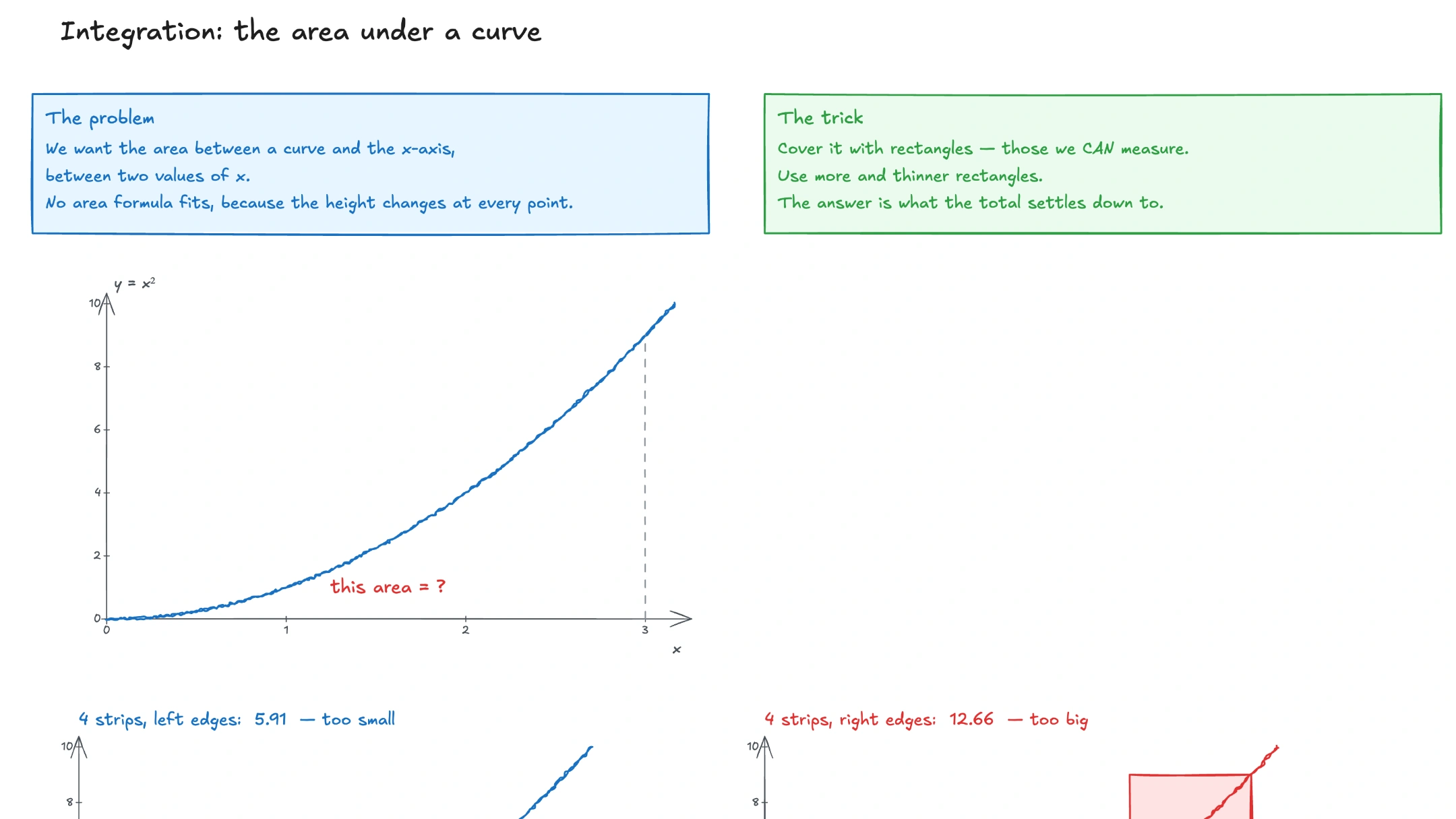
Finding the area of a rectangle, triangle, or circle is easy because simple geometric formulas exist. But how do you find the area under an arbitrary curve like y = x² or y = sin(x)? For centuries, mathematicians struggled with this challenge until Gottfried Wilhelm Leibniz and Isaac Newton developed the calculus.
The breakthrough idea was approximation through subdivision: if you cannot calculate the curved area all at once, chop it into dozens of thin vertical slices that look almost like ordinary rectangles, add up their areas, and see what happens as the slices become infinitely thin.
Step 1: Building Riemann Sum Rectangles
Consider the interval [a, b]. Divide it into n equal subintervals, each with width Δx = (b − a)/n. Over each subinterval, construct a vertical rectangle whose height is given by the function value f(x*):
• Left Riemann Sum: Evaluates height at the left endpoint of each subinterval.
• Right Riemann Sum: Evaluates height at the right endpoint.
• Midpoint Sum: Evaluates height at the center of each subinterval.
Each rectangle has area = height × width = f(x_i*) · Δx. Summing all n rectangles gives an estimate of the total area: Area ≈ Σ [i=1 to n] f(x_i*) · Δx.
Step 2: The Limit and the Anatomy of the Integral Symbol
As we increase n from 4 to 100 to 1,000,000, the jagged staircase of rectangle tops hugs the curve tighter and tighter. In the limit as n ⟶ ∞ (or equivalently, as rectangle width Δx ⟶ 0), the approximation becomes exact!
Look closely at the notation Leibniz invented: ∫[a to b] f(x) dx:
• The ∫ symbol is literally an elongated letter 'S' for 'Sum'.
• a and b are the lower and upper bounds of integration.
• f(x) is the height of each infinitesimal slice.
• dx is the infinitesimal width of each slice (the limiting form of Δx).
An integral is not an abstract riddle; it is an infinite sum of infinitesimally thin rectangle areas!
Signed Area vs. Geometric Area: The Exam Trap
A critical distinction on the AP Calculus exam is signed area versus total geometric area:
• Definite integrals compute NET SIGNED AREA. Wherever f(x) lies above the x-axis, f(x) > 0 and the area is positive. Wherever f(x) dips below the x-axis, f(x) < 0 and the area contribution is NEGATIVE.
For example, ∫[0 to 2π] sin(x) dx = 0! The positive hill from 0 to π exactly cancels the negative valley from π to 2π.
If an exam question asks for 'total area between the curve and the x-axis,' you must integrate the absolute value: split the integral at every x-axis intercept and add the magnitudes.
How Claryfied Animates Integration on the Whiteboard
In Claryfied, this abstract limiting process is made visually obvious. The AI tutor sketches the coordinate axes, graphs the function, draws individual Riemann rectangles with labeled Δx widths, and visually animates the transition from chunky blocks to smooth, shaded definite integration while explaining every algebraic step out loud.
Watch our live integration whiteboard lesson on Claryfied, or enter any definite integral from your calculus homework to watch the derivation and area calculation drawn live!
What to remember
- Definite integrals calculate net signed area: regions above the x-axis are positive; regions below are negative.
- The integral symbol ∫ is an elongated 'S' for 'Sum' (Latin summa), and dx represents an infinitesimally narrow rectangle width.
- Riemann sums approximate area using finite rectangles; taking the limit as Δx ⟶ 0 yields the exact integral.
- The Fundamental Theorem of Calculus connects derivatives and integrals as exact inverse operations.
- Claryfied animates Riemann rectangles shrinking into smooth curves on a live whiteboard with 5 free lessons.
Frequently asked questions
How does the Fundamental Theorem of Calculus evaluate integrals without drawing rectangles?
The Fundamental Theorem proves that differentiation and integration are inverse operations. Instead of computing infinite Riemann sums, you find an antiderivative F(x) such that F'(x) = f(x), and simply evaluate F(b) − F(a).
Can an integral have negative area?
A definite integral can produce a negative numerical value if the region lies below the x-axis (or if the limits of integration are reversed from right to left). In physical applications like work or displacement, a negative integral represents negative work or reverse motion.
Can Claryfied handle integration by parts and u-substitution?
Yes! Claryfied handles all AP Calculus integration techniques, writing out u and du substitutions, changing limits of integration, and drawing the corresponding area transformations.
Watch Integration Built from Rectangles Live on Claryfied
Play this complete interactive lesson free—drawn and narrated from start to finish. Or enter your own homework problem to get 5 lessons free.