The Unit Circle: Visual Guide to Sine, Cosine, Radians and Quadrants
Master the unit circle without memorization. Understand cosine as x, sine as y, radians, reference triangles, and quadrant sign rules with Claryfied.
Level: High School Pre-Calculus, Algebra 2, Trigonometry, AP Calculus
In this guide
Quick answer
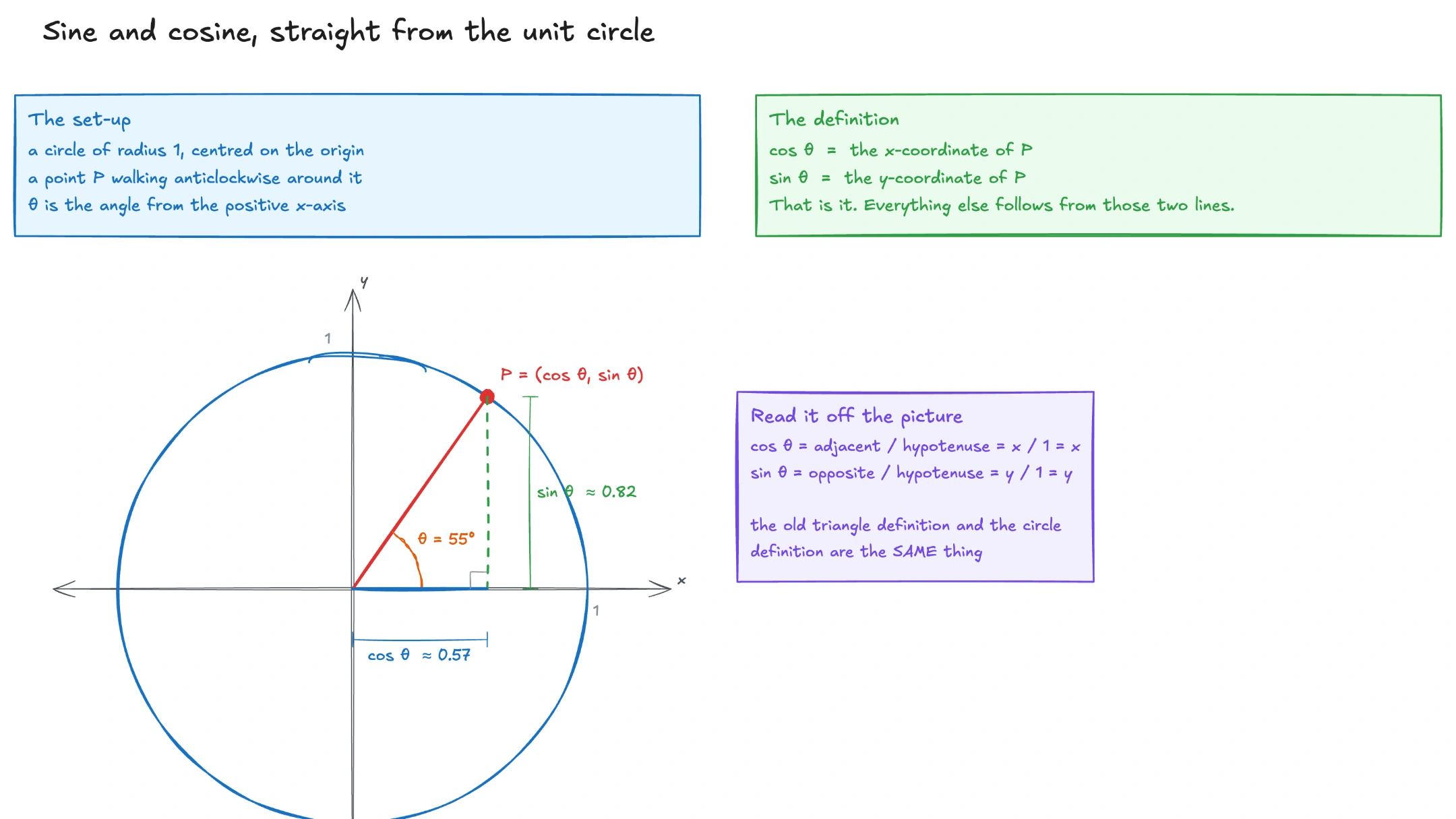
The unit circle is a circle of radius 1 centered at the origin (0, 0) of the Cartesian coordinate plane. For any angle of rotation θ measured counterclockwise from the positive x-axis, the coordinates of the terminal point on the circle are defined exactly by (x, y) = (cos θ, sin θ). This transforms trigonometry from right-triangle ratios into continuous coordinate functions for all real angles.
Key relationships & formulas
- Circle equation: x² + y² = 1
- Point Coordinates: P(θ) = (cos(θ), sin(θ))
- Pythagorean Identity: cos²(θ) + sin²(θ) = 1
- Tangent definition: tan(θ) = y / x = sin(θ) / cos(θ)
- Radian conversion: π radians = 180° ⟹ 1 rad = 180° / π
- Special coordinates (30° / π/6): (√3/2, 1/2)
- Special coordinates (45° / π/4): (√2/2, √2/2)
- Special coordinates (60° / π/3): (1/2, √3/2)
Why SOH CAH TOA Fails for Angles Beyond 90°
In middle school, trigonometry is introduced through right triangles: Sine = Opposite / Hypotenuse, Cosine = Adjacent / Hypotenuse. This works nicely for acute angles between 0° and 90°.
But what is the sine of 150°? What is the cosine of 270° or −45°? A right triangle cannot have an angle of 150°! When students try to force right triangles onto large angles, they hit a cognitive wall. The unit circle solves this problem by redefining sine and cosine as coordinate projections on a circle of radius 1.
The Universal Coordinate Definition: (cos θ, sin θ)
Draw a circle of radius r = 1 centered at (0, 0). Start at the positive x-axis (1, 0) and rotate counterclockwise by angle θ. The line segment from the origin to the circle forms a radius of length 1.
Drop a vertical line from the point down to the x-axis to create a right triangle:
• The hypotenuse is 1.
• The adjacent horizontal side along the x-axis is x = cos(θ).
• The opposite vertical side along the y-axis is y = sin(θ).
This is the most important insight in precalculus: cosine is the horizontal position; sine is the vertical position! By the Pythagorean theorem, x² + y² = 1 immediately gives the famous Pythagorean trigonometric identity: cos²(θ) + sin²(θ) = 1.
Stop Memorizing 16 Coordinate Pairs: Use the Three Families
Many textbooks make students memorize a chaotic chart of 16 coordinate pairs. In reality, there are only THREE reference triangles to remember, all originating from basic geometry:
- • The 30° (π/6) Family: Long horizontal leg, short vertical leg ⟹ (√3/2, 1/2).
- • The 45° (π/4) Family: Equal isosceles legs ⟹ (√2/2, √2/2).
- • The 60° (π/3) Family: Short horizontal leg, long vertical leg ⟹ (1/2, √3/2).
Navigating the Four Quadrants and Signs
When you rotate past 90° into Quadrant II, your x-coordinate becomes negative while your y-coordinate stays positive. That's why cos(150°) = −√3/2 while sin(150°) = +1/2. You do not need to memorize arbitrary sign acronyms like 'ASTC' if you simply look at where the point lies on the x and y axes:
• Quadrant I (0 to π/2): x > 0, y > 0 ⟹ Both cos and sin are POSITIVE.
• Quadrant II (π/2 to π): x < 0, y > 0 ⟹ Cosine is NEGATIVE, Sine is POSITIVE.
• Quadrant III (π to 3π/2): x < 0, y < 0 ⟹ Both cos and sin are NEGATIVE.
• Quadrant IV (3π/2 to 2π): x > 0, y < 0 ⟹ Cosine is POSITIVE, Sine is NEGATIVE.
How Claryfied Makes Trigonometry Intuitive
In Claryfied, the unit circle is drawn stroke by stroke. The AI whiteboard tutor sketches the circle, rotates the radius vector by your exact angle θ, drops the perpendicular right triangle, highlights the horizontal cosine projection in blue and vertical sine projection in purple, and derives exact values with voice narration.
Watch our live unit circle lesson on Claryfied with no account required, or type in any trigonometric angle or identity to watch Claryfied sketch and solve it on your own whiteboard.
What to remember
- On the unit circle, the x-coordinate IS cos(θ) and the y-coordinate IS sin(θ); tangent is the slope y/x = sin(θ)/cos(θ).
- Because radius r = 1, the Pythagorean theorem x² + y² = 1 immediately yields the identity cos²(θ) + sin²(θ) = 1.
- Quadrant signs follow the coordinate axes naturally (x is negative in Quadrants II & III; y is negative in III & IV).
- Every angle on the unit circle is just one of three basic reference triangles (30°, 45°, 60°) reflected into different quadrants.
- Claryfied sketches the circle, projects right triangles in color, and speaks the radian derivations out loud with 5 free lessons.
Frequently asked questions
Why is the radius of the unit circle set to 1?
Setting the radius to 1 simplifies the trigonometry formulas because the hypotenuse is 1. Since cos(θ) = adjacent / hypotenuse = x / 1 = x, the x-coordinate directly equals cosine, eliminating unnecessary division.
How do you convert degrees to radians on the unit circle?
Because one full circle of 360° corresponds to a circumference of 2π radians, 180° = π radians. To convert degrees to radians, multiply by π/180°. For example, 60° × (π/180°) = π/3 radians.
Can Claryfied solve trigonometric equations and prove identities?
Yes! Claryfied can solve equations like 2 sin²(x) + sin(x) − 1 = 0 and prove complex trigonometric identities, illustrating the unit circle positions and algebraic steps side by side.
Watch the Unit Circle Sketched Live on Claryfied
Play this complete interactive lesson free—drawn and narrated from start to finish. Or enter your own homework problem to get 5 lessons free.