Projectile Motion: Visual Guide to Range, Maximum Height and Formulas
Master projectile motion by splitting velocity vectors into horizontal and vertical components. Includes derivations, trajectory diagrams, and interactive lessons.
Level: High School, AP Physics 1, Introductory College Physics
In this guide
- Why Projectile Motion Confuses Students in Textbooks
- Step 1: Resolve the Launch Velocity into Orthogonal Vectors
- Step 2: Deriving Peak Height and Total Flight Time
- Step 3: Calculating Horizontal Range and the 45° Rule
- How Claryfied Draws and Explains Projectile Motion in Real Time
- What to remember
- Frequently asked questions
Quick answer
Projectile motion is the two-dimensional motion of an object under constant downward gravitational acceleration with zero horizontal acceleration (ignoring air resistance). By resolving initial velocity v₀ into v₀x = v₀cosθ and v₀y = v₀sinθ, the motion splits into constant horizontal velocity and vertical free fall, yielding peak height H = (v₀²sin²θ)/(2g) and range R = (v₀²sin2θ)/g.
Key relationships & formulas
- Horizontal velocity: vx = v₀ cos(θ) [Constant]
- Vertical velocity: vy(t) = v₀ sin(θ) − g t
- Horizontal displacement: x(t) = (v₀ cos(θ)) t
- Vertical displacement: y(t) = (v₀ sin(θ)) t − ½ g t²
- Time to maximum height: t_peak = (v₀ sin(θ)) / g
- Total flight time (level ground): T = (2 v₀ sin(θ)) / g
- Maximum height: H = (v₀² sin²(θ)) / (2g)
- Horizontal range: R = (v₀² sin(2θ)) / g
Why Projectile Motion Confuses Students in Textbooks
In almost every high school and AP Physics course, projectile motion is the first major topic where one-dimensional kinematics expands into two dimensions. Textbooks throw a dozen subscripted formulas at you: v₀x, v₀y, ax, ay, t, H, and R. Without a visual model, students scramble to guess which equation applies to which axis.
The fundamental secret that unlocks all projectile problems is independence of perpendicular motions: what happens horizontally has zero effect on what happens vertically. A bullet dropped from shoulder height hits the flat ground at the exact same millisecond as a bullet fired horizontally from the same height.
Step 1: Resolve the Launch Velocity into Orthogonal Vectors
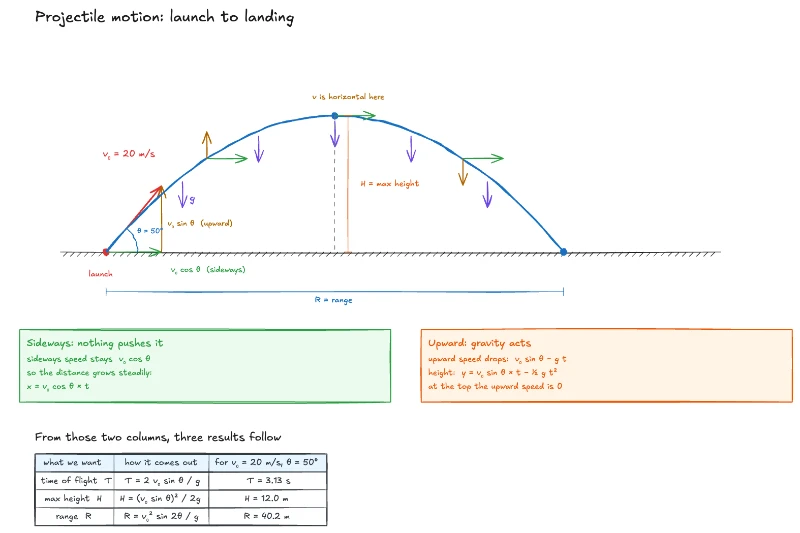
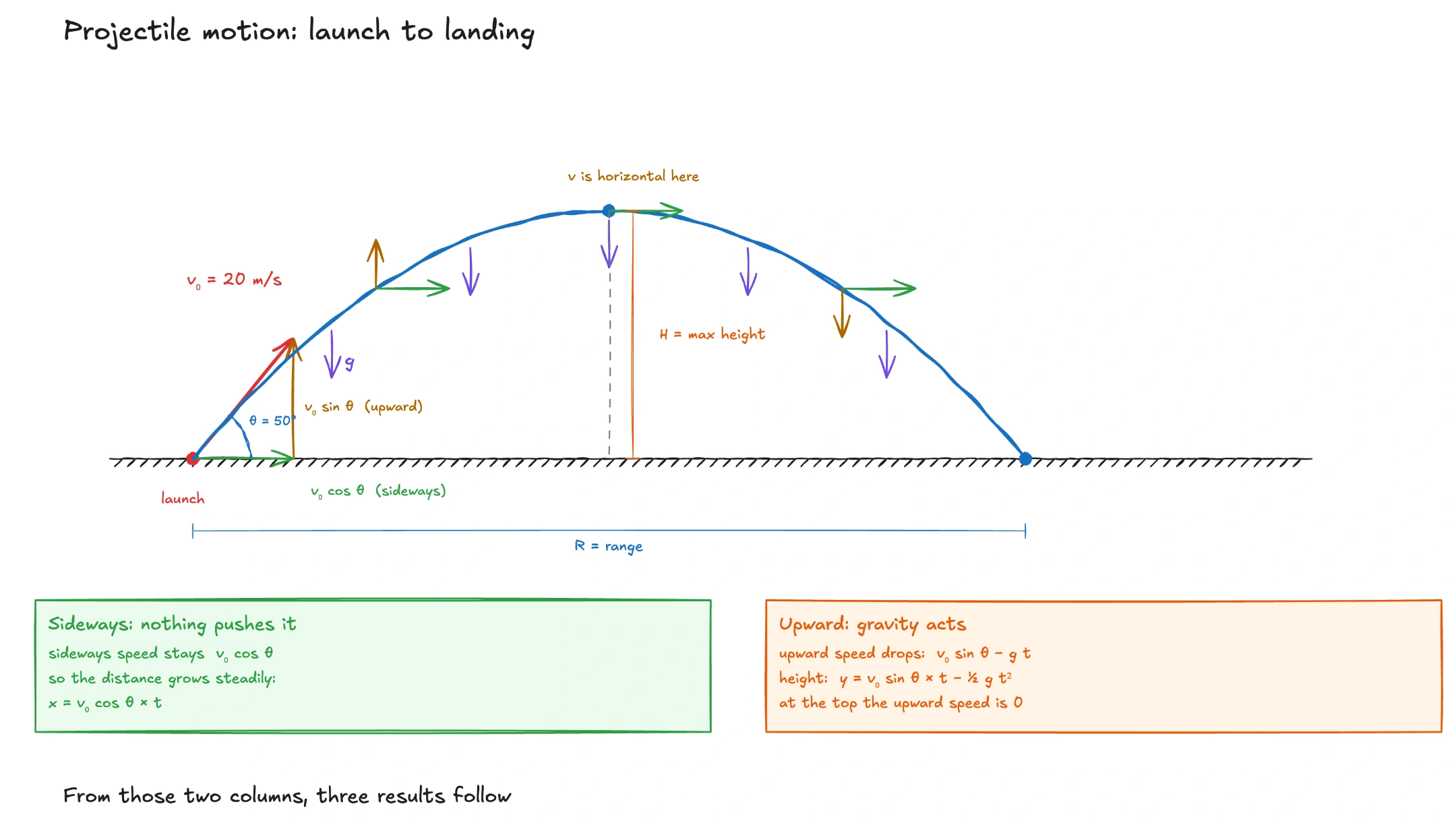
Consider an object launched with initial speed v₀ at an angle θ above the horizontal. Before touching any kinematic formula, resolve the launch vector into its right-triangle components:
• Horizontal component: v₀x = v₀ cos(θ). Since we neglect air resistance, horizontal acceleration ax = 0. Therefore, the projectile glides forward at constant speed forever until impact: x(t) = (v₀ cos θ)t.
• Vertical component: v₀y = v₀ sin(θ). Earth's gravity exerts a constant downward force, giving ay = −g (where g ≈ 9.8 m/s²). The vertical speed decreases on the way up, stops momentarily at the peak, and accelerates downward on the way down.
Step 2: Deriving Peak Height and Total Flight Time
What happens at the very peak of the trajectory? A common exam trap is thinking the projectile 'stops.' It does not stop—it is still cruising horizontally at v₀ cos(θ)! Only its vertical velocity component vy momentarily equals 0.
Using the kinematic equation vy = v₀y − gt, set vy = 0:
0 = v₀ sin(θ) − g t_peak ⟹ t_peak = (v₀ sin θ) / g.
Substitute t_peak into the vertical position equation y = (v₀ sin θ)t − ½gt² to obtain the maximum height formula:
H = (v₀² sin²θ) / (2g).
Because the trajectory is symmetrical over level ground, the total time of flight T is exactly double the rise time: T = 2 t_peak = (2 v₀ sin θ) / g.
Step 3: Calculating Horizontal Range and the 45° Rule
The horizontal range R is simply the horizontal distance traveled during the total flight time T. Multiply constant horizontal velocity by T:
R = v₀x · T = (v₀ cos θ) · (2 v₀ sin θ / g) = (v₀² / g) · (2 sin θ cos θ).
Recalling the trigonometric double-angle identity 2 sin(θ) cos(θ) = sin(2θ), this simplifies to:
R = (v₀² sin 2θ) / g.
Because sin(2θ) reaches its maximum possible value of 1 when 2θ = 90° (which means θ = 45°), a 45° launch angle maximizes horizontal distance on level ground. Furthermore, because sin(2(90° − θ)) = sin(180° − 2θ) = sin(2θ), complementary angles like 30° and 60° land at the exact same spot!
How Claryfied Draws and Explains Projectile Motion in Real Time
In Claryfied, this entire lesson is not just a block of text. When you watch the lesson on Claryfied, the AI tutor literally sketches the x and y axes on an Excalidraw whiteboard, launches the projectile, draws the tangent velocity vector, breaks it into colored component vectors, traces the parabolic curve, and derives H and R step by step while narrating aloud.
You can watch this complete lesson right now in our live sample board with zero signup required. And if your homework question has specific numbers—like a soccer ball kicked at 22 m/s at 35° from a 10m cliff—simply type it into Claryfied to watch your custom scenario sketched and solved!
What to remember
- Horizontal and vertical motions are completely independent, linked only by the shared flight time t.
- Horizontal velocity vx remains constant throughout flight because no horizontal force acts.
- At maximum height H, the vertical velocity vy is zero, but the horizontal velocity vx is still active!
- Complementary launch angles (e.g., 30° and 60°) achieve the exact same horizontal range on level ground.
- Claryfied sketches the full trajectory, draws velocity vectors in color, and solves your exact homework numbers with 5 free lessons.
Frequently asked questions
Why does horizontal velocity stay constant during projectile motion?
Gravity acts purely in the vertical direction (downward). Because there is no horizontal force acting on the projectile (ignoring air resistance), Newton's First Law dictates that horizontal velocity remains completely constant.
Why do 30° and 60° launch angles produce the same range?
The range formula depends on sin(2θ). For 30°, sin(2 × 30°) = sin(60°) ≈ 0.866. For 60°, sin(2 × 60°) = sin(120°) ≈ 0.866. The 60° projectile goes higher and stays in the air longer, while the 30° projectile moves horizontally faster for a shorter time, landing at the exact same spot.
Can Claryfied solve projectile problems launched from an elevated cliff?
Yes! Type your exact problem (initial velocity, angle, cliff height) into Claryfied, and the whiteboard tutor will draw the cliff, track the asymmetric flight path, and solve the quadratic equation step by step.
Watch the Full Animated Projectile Motion Lesson on Claryfied
Play this complete interactive lesson free—drawn and narrated from start to finish. Or enter your own homework problem to get 5 lessons free.